Thursday, May 22, 2014

Educational Tour

From May 2nd through May 4th, I went on an "educational tour" around parts of Northern Luzon I hadn't gotten much of a chance to visit yet.  In other words, Padie Alyse and Ma'am Bridget took me on vacation to go see Sagada and Banaue and a few other spots along the way.  This is going to be mostly pictures, because the photos are better than any amount of verbal description:

The route: Dad put this together to help me explain it after I told him all about the trip:

 The trip up started with us stopping to take pictures at a few Episcopal Churches along the way:


 And at a few other sites:

We reached Bontoc in time for lunch, and afterward met with the Bishop there.  No pictures of that, sorry.  We headed over to Sagada and stopped for an afternoon tea with some Easter College graduates while it was pouring down buckets of rain.  It was worth the rain, though, for this rainbow:
It's faint in the picture, but in person you could really see the twin rainbows. 

And then there was another church before evening, the one in Busao, where Ma'am Bridget is from:
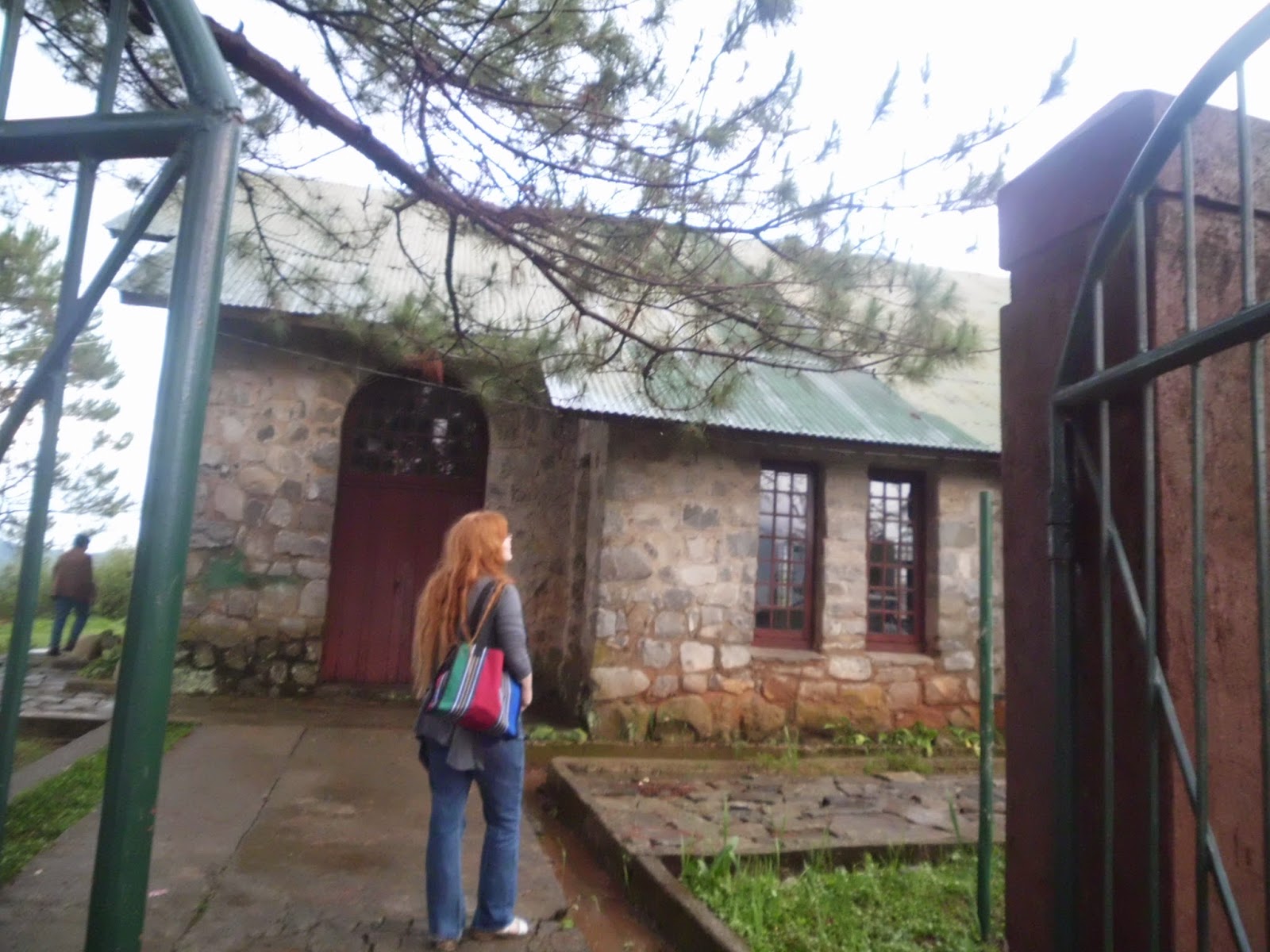


We stopped at the church right before sunset, then headed over to Ma'am Bridget's aunt's house, which was free for the night.  Her aunt and uncle are currently living in the US, so any time family shows up back in Busao, they stay over at that house or with others at the family compound. 

The next day was exploring Sagada.  First up, caves!  Now,  I didn't get any pictures of within the cave I went climbing in, because I knew better than to take my camera in and expect anything to come out.  So instead, here's a picture of me with my guide after we came out, both soaking wet from the water running through the cave system:
We also went to look at a separate cave with hanging coffins.  It's a traditional burial practice, and the last person to be buried like this in the region was buried about 3 years ago, though in a further off section than we made it to:


In the last picture you can see some of the coffins wedged against a sheer cliff face. 

They stopped and bought me some spare clothing so I wouldn't be walking the rest of the day in soaking wet jeans, and then we went to the church in Sagada, which has an amazing altar:
 That's native rock below, and a hand-carved crucifix. 
The pants are a bit brighter than I'd normally wear, but Sara will love them. 

We also went to the museum in Sagada, which was full of artifacts of the Cordillera region and the Igorot lifestyle, but we weren't allowed to take pictures inside.  Suffice it to say, it was an anthropologist's dream, all collected by one woman over the course of 30 years, and the museum was only started after she fought off cancer. 

The next day was Sunday, and we took the long way back to Baguio to stop at Banaue Rice Terraces, something which used to be the 7th wonder of the world:

 Our drive out from Sagada early in the morning.  We were above the clouds at dawn. 


It's before the rice planting season, so the terraces weren't at their best.  Still, think about what it takes to build all of that from mud, and then repair it every year to keep growing rice. 

We stopped in a few gifts shops, and had the day of the hats:


And also a picture of a wooden scooter carved to look like a dragon, because why wouldn't you take a picture of that?

We also stopped at the Kiangan Shrine, where the last Japanese in the Philippines surrendered after WW2:


 Taken at the top of the shrine.
Padie Alyse, Me and Ma'am Bridget, from left to right.

By mid-afternoon, we were driving through some of the lowlands as we circled back to Baguio, and ran into this resort:
We got ice cream, but didn't stop to go swimming. 

We also visited our driver's family farm, and got bananas for an afternoon snack:


Water Buffalo!

We were almost back to Baguio when we made our last stop, at the hydro-electric dam that powers half of Northern Luzon:


We took the pictures right before the evening rain and sunset hit. 

After that, it was driving through the dark back up to Baguio, and getting all of us out and back to our homes.   I think all of us slept for a good chunk of the following Monday. 

Thursday, May 8, 2014

Graduations and Transitions


I’ve been stalling on this entry for over a month and a half, at this point.  Easter College’s high school graduation happened back in mid-April, and at that point my work as a volunteer began to change over.  I’m not working as much with the school, though I still have four papers from my students in the Lay Institute that I need to finish grading before I will officially be done as a teacher in the Philippines. 

For the past month and a half, I’ve been working more with the diocese, and with the national church, visiting and attending conferences, working with a vacation Bible school, getting to be present at church events.  It’s been a bit of a transitional period for me, especially as it leads into the knowledge that I’m leaving soon. 

I’ve talked about the JCPC conference in Manila, and otherwise, the thing I’ve enjoyed most about working with the diocese has been the VBS work I did with the Cathedral.  I spent my time working with Sister Remy with the 7-10 year old group.  Which really meant that I did a lot of playing games with small children, then reading Bible stories and explaining the value for that day.  Again, bubble solution breaks down most barriers, and was also quite helpful at distracting random crying fits from a few of the younger students. 

I’ll close with pictures of both the high school and VBS graduation ceremonies:  
 Sir Jordan, still teaching till the end, even if it's only how to tie a tie. 

 The entire graduating class, wearing traditional tapis/traditional cloth for the ties as opposed to graduation robes.  That really was the main difference between this graduation and all the other high school graduations I've been to. 
 The VBS students singing in church before their graduation ceremony.
 Putting on a dance for the parents.
 More dancing!  The girl in the pink dress latched on to me and was dragging me around by my arm up until the ceremony began. 
 This little boy was the absolute cutest trying to dance along.

Sunday, April 13, 2014

JCPC Friendship


I’ll admit, I had very little information and even less of an idea what was going to go on when Attorney Floyd called me up a month ago and told me I was going to go to the JCPC conference in Manila. I wasn’t even sure what JCPC was.  That didn’t stop me from saying yes to going, of course.  If I had to know what I was getting into before I did it, I never would have joined YASC or come to the Philippines.  Looking back, even if Attorney Floyd had explained what JCPC was, I wouldn’t have expected this conference. 

JCPC, for those not intimately aware of the relationship between the Episcopal Churches in the Philippines and the US, means Joint Committee on Provincial Companionship.  It is a group with a nearly 30 year long history, beginning when the Episcopal Church in the Philippines first decided to become an autonomous church within the Anglican Communion, as opposed to a mission church under the jurisdiction of the Episcopal Church in the US.  The JCPC was put together to plan and monitor the transitional period, and as a method of maintaining the ties of friendship between the two churches in the process and beyond.  These JCPC conferences occur every 18 months or so, hosted alternately by the delegates in America and the Philippines.  This year it was the Philippine Church’s turn, and we in YASC were invited specifically to help boost the American numbers if it came to a fist fight.  Well, also because we serve as living examples of the partnership between both churches, but the fist fight idea was more fun. 

Aside from my fellow YASC members and I, there were a few other people who were newish to the JCPC, including, I think I heard correctly, both American bishops present.  (Bishop Bob Fitzpatrick of Hawaii and Bishop Dave Bailey of Navajoland, both absolutely fantastic human beings.)  Therefore, one of the first things that happened during the conference was Attorney Floyd telling the story of how the ECP became financially independent from the ECUSA.  I can’t do it justice in this blog post, but the essence is that at a certain point in the proceedings, the ECP took a giant leap of faith, cut the umbilical cord, and started focusing on what they could do for themselves rather than on what they needed to get.  Everyone involved thought it was going to be a disaster to cut the funding early, but as they put it at the time, “If we are to die, better to die early and resurrect early as well.”  It succeeded beyond their wildest imaginings: the first year they were entirely financially independent they went from a 6.3 million peso shortfall, even with the financial support from the ECUSA, to a 3 million peso surplus. 

What American community developers are starting to call ABCD, Asset-Based Community Development, is something the Philippine Episcopal Church developed the hard way, by putting it into practice and developing the theory later.  This principle still governs how the Philippine church plans new churches and communities, as well as how it does aid work. 

With the reality of the financial autonomy of the ECP as well as the legal/jurisdictional autonomy, the JCPC has found its focus shifting.  The common metaphor within the conference was that now instead of being a parent-child relationship, with the ECUSA as a mother providing extra resources and guidance, it is now becoming a relationship of true equals.  Part of that relationship is deciding how the two churches are to interact, and whether we should remain so tightly bonded.  The fact that we are keeping the JCPC going is now a choice to remain closely aligned friends, a choice that recognizes that the ECUSA will have as much to gain and learn from the ECP as the ECP does from the ECUSA. 

And that truly was the main theme of the conference.  We were there to tell each church stories of what is going on, to build more bridges and learn from one another.  It was just as common for one of the American bishops to start frantically jotting down notes as an ECP member told their story about solving difficulties as it was for an ECP delegate to do the same, especially as the conference transitioned into the storytelling.  Both American bishops are from dioceses that are primarily indigenous groups, and the ECP is primarily an indigenous church as well, given where in the Philippines it has its strongest roots, and there was a good deal of discussion of what it means to be a member of a church that has strong missionary roots but still respect the native culture. 

There was also the point where all the delegates put us YASC members on the spot.  We had very little warning when the bishop from Northern Luzon turned and said that as they were discussing the partnerships between the churches and the focus of YASC, that they’d like to hear a bit from each of us about what our YASC year was about.  I have no idea how Andrew and Ashley managed to speak as eloquently as they did, I was trying not to trip over my own tongue as I described the year I’ve had and tried to boil down something so marvelously complex into a few minutes’ worth speech. 

And nothing I’ve written so far has, I think, gotten across how fun this conference was.  Possibly because there was no need to talk about a budget or finances, or to justify money matters, everyone was rather relaxed throughout, and we spent a good deal of time laughing and enjoying ourselves throughout.  And being fed, because this is the Philippines and food is important for fellowship, so every few hours we stopped and ate, having some more relaxed/unstructured time for conversation.  Relaxed bishops/upper muckity mucks of two different churches means that there are people with a lot of absolutely hilarious stories, and the long-running friendships in many cases meant that they all had a lot of fun telling them, and coming up with “can you top this” style stories.  Bruce Woodcock, in particular, who came as a representative from the Church Pension Group and also because he’s been visiting the Philippines for the past 30 years, had some of the best, mostly focusing on things which happened as a Peace Corps volunteer in Africa. 

Sunday, March 16, 2014

Found in Translation


This Sunday, Eliza sat next to me in church.  She normally attends Cathedral of the Resurrection, it didn’t come up during our conversation why she chose to come to Holy Innocents today.  Her little sister attends Easter, I’ve actually been teaching her this year.  The majority of the sermon was in Illocano, a dialect neither of us speaks well.  As I said to her, I can understand about one word in twenty, and most of that is words like and, but, just like: words that give important linkages in a sentence, but which convey very little meaning.  Between her understanding of Tagalog and the loaner English words peppering the sermon, we were able to get at the gist of the sermon.

This happens fairly often in the churches I attend in the Philippines.  When a people are nominally tri-lingual, grew up speaking their native dialect and learning both Filipino and English at school, what evolves isn’t always one straight language.  They code-switch, bouncing between languages depending on which language has the word that best conveys the meaning.  If, like me, you are slow at learning languages without formal instruction, it can sometimes be frustrating to no longer be able to catch all the meaning present.  It also gives me greater understanding of the fact that there are very often no good single translations of words, that one language can have a word where there is no concept of it in another language, and that these are the points where translation becomes a fine art, not a science. 

But having been here, it makes me understand a bit more of the Bible and the New Testament.  The languages of the disciples and Jesus would have been closer to the concepts of Filipino languages: Jesus and his disciples spoke a dialect off of Hebrew, and many of them could read written Hebrew.  The surrounding cultures spoke Greek and Latin, and at least some of the disciples, and the apostle Paul, learned Greek to communicate with that wider world. 

We do not ever have an exact Bible.  We have a multiplicity of translations, and even the earliest versions are translations: the writers of the Gospels and the letters taking a Hebrew and Aramaic speaking Jesus and theology and putting them into a form a Greek-speaker will understand.  There are words with subtleties of meaning in Greek or Hebrew that did not translate fully, there are still words we don’t understand perfectly because what they referred to is no longer a part of our world. 

But as we keep translating, we re-discover meanings.  Each time we have to play with the text to more closely get at a concept in a new language, we go deeper into the richness of the words we were given at the beginning of our faith.  We can rejoice that the form of poetry the Psalms were written into can translate across all languages, based more in parallelism than specifics of rhyme, rhythm and meter.  We can question again words, looking for translations that get across the poetry or the literal meaning or the sense, and recognize that you will not always get all three in one word or phrase.