Saturday, March 1, 2014

Three Stories of Sara

I've already discussed a few times before that one of the central themes of this year for me has been telling our stories, and how changing the story changes the way you look at the world.

A few weeks ago, my eighth grade students were on the Gospels of the New Testament.  To explain why we had four gospels that all told different stories of Jesus, I started the class by having them each write a description of me in list format, and then we put up two student's versions of me up with a list of words my friends have used to describe me.  In all three classes, the lists ended up being very different from one another, to the point where an outsider coming in wouldn't assume they were talking about the same person.  

Outside of the class experience, I had another version happen to me, when I read a fellow church member back home's perspective of my sister Sara.  My first response was that while it was a truthful account of Sara, it did not reflect my version of her.  Both my father and I shortly thereafter wrote our own stories of Sara.  I got my father's permission to post his story up here on my blog along with my own.  

My story:

Sara is small, with fine-boned wrists and a slender frame. She would have been a petite woman even without her disability retarding her growth, but as it is I dwarf her, although I myself am not what one would call tall. She is fair, with pale skin, dirty-blond hair kept short, and china blue eyes. She is visibly disabled, sitting in her purple stroller; her limbs don't always go in the direction she plans and parts of her face and head are slightly disproportionate. She drools often, and chews on anything she can get into her mouth. The fronts of all her shirts and dresses are permanently stained from this, no matter how often we wash her clothes or how many detergents we try.

Her entire life is marked and shaped by her disability. When the family is asked to explain exactly what is wrong with her, we respond that she has microcephalus, that parts of her brain did not develop and as a result she has profound mental retardation, cerebal palsy, and seizure disorder. If we are asked to explain the limits of her disabilities, it is often easier for us to explain what she can do than what she is unable to do. The former is a lot shorter of a list than the latter.

Sara is unaware of this, just as she is so unaware of her disability that it ceases to have any meaning to her. Sara doesn't know what she cannot do, or how strangers might see her. Sara only knows what she can do. She knows that she can play with all sorts of toys, though her favorites are her music box and her beads. She knows that she can recruit people passing by into playing with her if she drops her beads in front of them. Since she mostly deploys this tactic at church, inside the family we often say that she's taking Jesus's instruction to be fishers of men rather seriously. Sara knows what she likes and doesn't hesitate to make her opinions known. We know that her favorite color is purple, because she always picks it if she's given a chance. We know her favorite foods in a similar way, she will always make her way straight to them if given half a chance. No chocolate cake is safe if it is within arm's length, and she's always willing to redefine arm's length if the end result is chocolate.

We know as well what Sara loves. She loves her family, and will sometimes stop us as we walk past and pull us down into a hug that only ends when she's done with it. She loves music of all kinds, and will laugh with joy when she sees it played live. She lights up and bounces when she goes to places she likes or when she recognizes people she enjoys, and she's better at remembering people's faces than the rest of the family combined.

We know her personality. We know that she is extroverted, because she's happiest when there are people around her to interact with. We know she is stubborn, and will not cooperate if it's not what she wants to do. She knows her routines, and gets indignant when people change them on her without her permission. She is creative and determined, and has frequently ended up in places we didn't think she could reach, or grabbed things we didn't think she could get at. She loves playing with textures, and sometimes that means she has messed up my father's cross-stitch or torn important documents because the feel of ripping paper or tangled threads was interesting to her.

No one in the family is unaware of the difficulties that life with Sara can present, and has presented in the past. There are things we have not done, places we have not gone, because Sara would not make it there. There are rough days, days when it takes extra effort to take care of her, days when her stubbornness is more of a challenge than not. But at the same time, none of us can imagine a life without her, or understand when people ask us if we ever are bitter or resent her. She is loved because she exists, in the same way we love the rest of our family members. If anything, because we never have fights with her and all of her issues are purely physical, we kids sometimes found it easier to love her than we did our other siblings when we were young and fighting with one another.
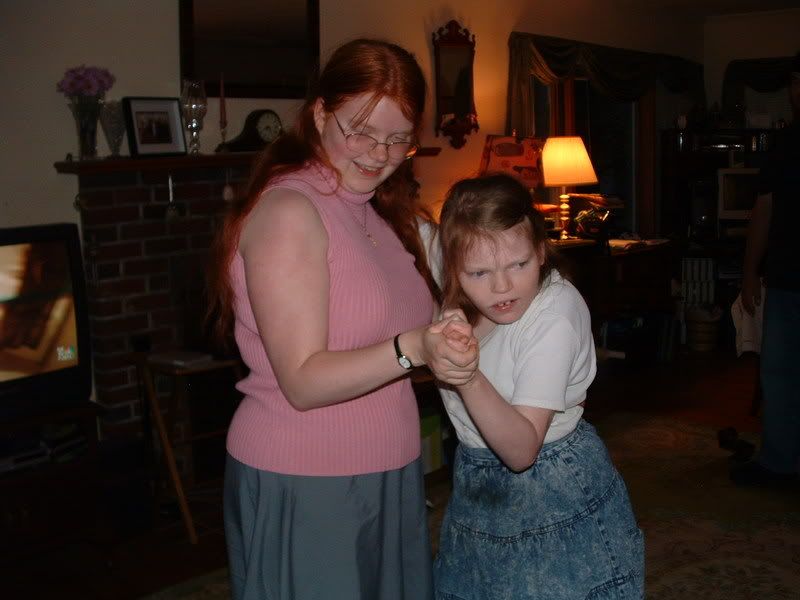


Dad's Story: 

A member of our parish described our daughter Sara as she sees her, Sunday mornings in church, and used her as a lesson in how we as Christians are supposed to take care of “the least of these”.  My daughter responded on her blog that this was a story that contained the truth about Sara, but that it wasn’t her truth.  She provided an alternate version, which was true for her as a sister to Sara, and suggested that my narrative and my wife’s might be different.  Here’s my story.

First, the facts.  Sara is thirty years old chronologically, and between one and two years old developmentally.  Even that isn’t completely accurate, in that Sara is younger than that in some ways, and older than that in others.  She is microcephalic, meaning that her brain is too small and incompletely developed, so that her head appears to be too small for her small body frame.  The poorly-developed brain means that some of the brain cell connections are miswired, so she goes through epileptic seizures if they are not controlled by medication.  The poorly-developed portions of her brain also mean that she won’t develop or learn with time.

Her disability is really spotty.  She can’t take care of herself, but can remember that after meals, we wash her hands first and then her face, and remembers (every time) to try to hide her face from the washcloth.  She can’t talk, but she can vocalize enough to communicate emotions and feelings.  She has an incredible memory for faces.  The first time we showed up at the church we are at now, she enthusiastically greeted a woman we thought was a total stranger.  It turned out, the woman worked as a sign language interpreter at a summer camp Sara attended a year and a half earlier.  No, she doesn’t understand sign at all.  She’s also the best judge of character we’ve ever seen.  A couple interviewed my wife about taking care of their adopted daughter.  All we knew about him was he was a used car salesman.  Not ten minutes into the interview, Sara crawled up into his lap.  He and his wife are two of the best parents we’ve met in day care, but Sara knew it first. Margaret mentioned her love of music in any form.

None of this was apparent when she was born, and she didn’t show any signs of disability until her brain growth virtually stopped after six months.  Over the next few months, she just didn’t develop much further, and by the time she was a year old, we knew she would be profoundly affected.  Of course, with the slow onset of the disability, we had a chance to adjust to that disability very slowly as well.  We had no conscious period of adjustment to her condition, and neither did her siblings, both older and younger.  I believe that my wife and I really haven’t been changed that much by being her parents, but my kids have grown up being much more caring and accepting by growing up with her.

We did have to deal with a few religious prejudices over time.  There were those who suggested that Sara was disabled because of something we did, some type of profound sin that either Jane, or I, or both of us had committed, so that we were being punished for that sin.  Closely related to that was the belief that if we only had enough faith, we could pray and Sara would be healed.  Her continued disability was due to our lack of faith.  I reject any notion that Sara is either a punishment or a test of faith for us, and I’ll avoid any faith tradition that suggests that either is true out of hand.

The opposite tack was taken by other well-meaning friends, who have suggested that God gave us Sara because we are somehow more blessed, more patient, more caring or more loving than other parents, and therefore, we are “blessed” to have her in our life.  First, I don’t feel that blessed or that special.  In addition, there’s a lot of other kids who are equally disadvantaged, that might, or might not have the same opportunities that Sara has had to be loved.  There are at least three other sets of parents in our church that have been foster parents to difficult-to-place children, and even adopted the hardest cases when the foster children cannot be placed back with their parents, and there’s a couple that had to fight their daughter to get custody of their grandchildren.  Sadly, they just succeeded when their daughter died, probably due to a fatal drug interaction.  Our priest and his wife is one of the three foster parent couples, and is probably losing one of their adopted daughters, born deaf, losing her sight, and now hospitalized by some form of autoimmune disease.  Comparing ourselves to them, we’ve taken care of our own daughter, who is a delightful, loving child, in spite of her disabilities.  These other couples have voluntarily taken on difficult or hopeless cases.  They deserve the praise more than us.

At the same time, how many normal children have poor parents that don’t provide adequate role models.  How many disabled children don’t have great parents, but don’t make it into the foster care program.  How many disabled or at-risk kids are trapped with no foster parents or adoptive parents in their future?  To claim that God intended Sara to be born into a loving, caring home is God’s will when so many other children don’t have those same advantages mocks God’s benevolence.

No, as best as we can tell, Sara was the random victim of a stray cosmic ray, or of a flu virus in utero, leading to a random birth defect that led to her unique array of disabilities.  She had the good luck to be born into a loving family, with two parents who have stayed together, and has had siblings who have been raised to be good and caring people.  It’s just as likely that she would have been born to parents who might have given up on her, or to a single mother incapable of caring for her.  By these random chances, Sara has had a good life, but it is just as likely, or even more likely that other children in her situation haven’t been as fortunate.  I mourn for them.

These are the family stories.  Carole's version can be found linked here: http://cecdayton.wordpress.com/2013/11/11/the-least/

Tuesday, February 25, 2014

A Guest Speaker and a Whirlwind Tour


Back in November, Ma’am Kana and I were working on lesson plans for the students in the various grade levels of CE that we share.  At the end of the Fourth-year outline, there was mention of the Church’s role in society.  Immediately, I knew who I wanted to call in to speak about that.  Besides, it would give her an excuse to visit when Baguio wasn’t pouring down rain and fog. 

Fast-forward several months and the time came.  I invited Ashley Cameron to come up and visit, to talk about her work with the diocese of Santiago.  Before her visit, I threatened my fourth-year students with death/severe maiming if they weren’t good for Ashley, because I knew she was taking a lot of time out of her schedule for this visit right at her busy season. 

Ashley was a brilliant speaker, and I think the students got a lot out of it.  We can talk all we want about what Christian values are, but it takes seeing how they are applied on the ground to really understand what the Church should be about.  Ashley’s work in Santiago is about applying the baptismal creed to seek and serve Christ in all persons, to respect the dignity of every human being: her work in micro-finance gives her clients a sense of self-respect and dignity that is often under-represented in traditional charity.  Moreover, I think the students could see the love Ashley has for her work, how much she cares about and respects some of her clients as they work to improve their lives and their communities.  Students can always tell when you are being sincere, and even more than my threats, I think that’s what kept them listening and engaged for the most part. 

After our classes were over, it was time to explore more of the Baguio/La Trinidad area.  We specifically went to events and places to tour that would have been miserable last time in the rain: the Bell Church, Miner’s View, Tam-Awan Village.  And luckily, she was just in time to come and see one of the highlights of the year in Baguio: the Panabenga Flower Festival.  We watched the street dance parade on Saturday and each pretty much wiped out our cameras on photos of the dancers.  She couldn’t stay till Sunday to see the float parade, unfortunately.  As it was, we filled our Saturday to the point where we needed to race back to Easter College after dinner to get her bags before she caught a taxi out to the bus station.  

Photos!


This is the main building of the Bell Church.  The second you walk onto the grounds, you no longer feel like you are in the Philippines.  Everything around you looks straight out of China. 


There were dragons everywhere.  The fantasy geek in me who thinks that there is never such thing as too many dragons was thrilled.
It was only as we climbed up to a higher level of the church that we could start to see the surrounding city again.
The next morning was the street-dancing parade.  Ashley actually has video of some of the dancers.  We stood up on one of the walking overpasses to watch, and probably got a better view than if we'd been at street level. 


We left at the end of the parade and then headed out to Miner's View, a lookout point from the edge of Baguio into the surrounding mountains.


Forgive the squinting, I was staring up into light.

After lunch at Miner's View, we caught another cab out to Tam-Awan Village.  Tam-Awan is an artist's enclave started by BenCab, a famous Baguio-based artist.  I don't have many pictures from there, as we weren't allowed to take photos of the artist's work.  Tam-Awan is built going up the side of one of the surrounding mountains, and there's a hiking trail you can take up to see various views.  It was wonderful, and I'm going to visit again sometime when I'm wearing better shoes, as my sandals were not the best choice for going up and down very narrow and steep paths.

Both Ashley and I had our portraits sketched by artists working there.  This is how mine turned out:
Amazing for ten minutes work, right? 


Sunday, February 9, 2014

Another Anniversary

One year ago, I was at a weekend discernment and wrote this in my private journal:

But this weekend I've also been spending doing a discernment weekend for Young Adult Service Corps. And I'm so glad I've been here, because it has been the most sane-making and rewarding thing that I have done for months.

One of the other members of my small group called it finding our tribe, and there's definitely an aspect of that present here. These are very much my people: the young adults, mostly well-versed in religion (there's one exception and she is awesome and I want to live in her brain because it is a thing of beauty), all really eager to serve and help others, and discussing things we never get to talk about in our daily lives.

And I've gotten to spend time doing things like walking along a lake or lying in a field starwatching and talking about everything under the sun with the girl whose brain is fantastic. Or getting told by someone that I looked like I was part of a painting when I had been walking alone, with the last vestiges of the sunset on the water, and the trees full of Spanish moss, and my hair and skirt billowing in the breeze. Or starwatching again with the girl from before and a guy from our group, and not even needing to talk because everything we felt was understood.

I want to move forward with this mission, this work. But even if I don't get to continue, it was worth it just for this experience, these people.

The next day, on further reflection, I added this:

This weekend was absolutely incredible. You know how you get those perfect moments, the perfect conversations and silences together? The ones that come once in a blue moon if you're lucky, but can change you forever? In some ways it felt like this weekend was almost entirely comprised of those moments.

So thank you to H, for our conversations at the lake, cooing over lizards together, and starwatching. Thank you to P, for your beautiful lecto divino, chanting, and your wisdom and humor. You struck me as having that combination of thoughtfulness, insight, and gentle humor that I associate with the truly holy. Thank you M for your willingness to join in with humor, to break into song and dance, and for the way that you encouraged and supported everyone else when they would have been too scared to speak up on their own. Thank you to C, for airport conversations and joy. Thank you to Am, As, S, and R for making small group so safe, so fun, and so supportive. Thank you to J for your incredibly infectious giggles, and MD for playfulness. Thank you to Z for making me feel beautiful out of nowhere, and for stopping to notice the sky with me. Thank you Je for sharing cat stories our first night. Thank you to Ra for making me giving backrubs to everyone fun and accepted.

Thank you to Jason and Glenda for making the interview session non-scary. Thank you Chris, Elizabeth, and Robin for telling your stories. Thank you Camp Weed for incredible food and your beautiful chapel.

That weekend was the start of everything I am doing now.  Thank you again, for an incredible new year of my life.  

Happy Foundation Day/Charter Day (Week really)

I'm a bit behind in posting, but that's mostly because this week was a busy one.  Easter College was celebrating its 108th year as a school this week, and we've been having a lot of activities to keep us busy. 

Monday was a half-day for the students, as they were dismissed at lunch to go and watch the Chinese New Year celebrations.  We teachers stayed and had a vespers service to begin the week-long Anniversary Events.

(Okay, so there was a Fun Run on Sunday which officially began the proceedings.  But I consider Fun Run to be an oxymoron, and used my discretion about attending the non-mandatory event.  Sleep and church outranked running around parts of Baguio City.)

On Tuesday we had an academic bowl with some other schools in the city.  I didn't get to watch any of it, I was teaching in the morning and helping demonstrate a waltz step for the third and fourth years in the afternoon.  Junior/Senior Prom is this coming week, Feb 14th, you see, and apparently there are several formal dances they do during the prom.  Very different from my own senior prom, where I came mostly to say I had, and then spent a good chunk of it sitting with my best friend writing fanfic in a corner. 

Wednesday was the talent show, and I wish with everything I had that I had video of one of my fellow teachers during it.  I have no idea why he isn't already a Youtube sensation.  The man has such confidence that even when each of the dance moves is absurd you can't help but be drawn into it.  I mean, you laugh your head off afterwards, but he does a fantastic job of taking you along for the ride while he's in it. 

Friday was our ending celebration, starting with a gigantic school-wide mass, followed by an awarding ceremony for teachers and staff for years of service and then for teacher of the year.  And in the afternoon the college departments each took a lower year section of the school and had afternoon activities.

Saturday was the employee fun day, which meant we did exercise in the morning, played parlor games, danced, had a huge lunch, and then had a seminar on empowerment in the afternoon.  Saturday also had an alumni concert in the evening which sounded great, even from my room.  Although as I had to wake up at an absurdly early hour Sunday morning, I could have done with having it end sometime before midnight, or at least to have not switched into straight rock for the last few hours. 

Saturday, January 25, 2014

Storytelling


 A major theme that keeps coming up in my Lay Institute class is the concept of how our narrative shapes how we see the world.  We understand everything within the context of the stories we tell ourselves about how the world works, how we ought to be. 

For the past several weeks within that class, I’ve been telling the narrative of science.  The history behind many scientific discoveries, how science and scientists think of themselves and their goals, how science works.  Last Monday I had my father skype in for an interview, and he spent part of it telling the stories of geology, but mostly telling his own story.  Telling his experiences within geology and within the church, and how those stories shaped him into who he was.  With my permission, he also told the class stories about me, so they could see where I came from and what shaped me into the person sitting in that class, teaching in the way I do. 

One of the great things about teaching here in the Philippines is that I don’t have to explain why stories are important, why what we tell ourselves about the world matters in how we see things.  Everyone in my Lay Institute class gets that, gets the importance of story in telling truths.  They’re just as likely to say that the only way to tell real truths is to tell the story behind it, and I can’t disagree there. 

Our Lay Institute classes tend to run long, and to wander into discussions far afield of the original topics as we pursue those stories.  Often it brings us to surprising commonalities, moments of shared traditions between two cultures.  A discussion of Darwinian concepts of evolution turned into thoughts on immigration in the US, and into a history of the Irish immigration in particular, and from there into the similarities in how the Irish were viewed at that time and how Filipinos are viewed today, the parallels and repetitions only strengthening the truths we found. 

Over the course of this next week I’ll have to write a mid-term test to track what we have taught.  But how do I turn the brilliant, dynamic discussions we’ve held into something semi-objective?  No attempt I can come up with will truly track what has been learned here.  I don’t even know for certain everything that I’ve learned in the course of teaching.  But that in itself is its own gift: this class experience will never be summed up in a test and an outline of our course objectives.  It has already succeeded in its true goal of making us all think differently.  And the only way to describe that change?  Is in the stories we will tell from this point onwards.  

Saturday, January 11, 2014

St. James' Church Dedication


I’ve said that several of the clergy here in Baguio have taken to just deciding that I need to come along with them and visit various different churches and congregations when they are going to visit.  This past week was a perfect example of that, as Padie Alyse heard that St. James church in Balakbak was being consecrated and dedicated, and she took me out to participate in the dedication.

Balakbak is only about 40 km from Baguio, but it’s a pretty rough road through the mountains, so we’re talking a close to two hour trip on winding mountain roads.  When I wasn’t feeling somewhat carsick on the drive out, I was gleeing over the views, because the mountain road is just so pretty, and I really can’t believe I get to live here for this year.  


These photos were technically taken on the way back, but you can see what I mean about the views being spectacular.


We arrived in Balakbak early enough to catch a bite to eat with some of the congregation and a few visitors before the service started.  I’m starting to become a bit more known throughout the EDNCP, several of the clergy and a few visiting laity knew who I was before I was introduced.  Among the visitors to Balakbak were some visiting members of Ma’am Bridget’s family, so even though I didn’t get to meet them at her pre-New Years party, I hand a chance to say hello to them.  Ma’am Bridget had pointed me out to them yesterday, though we hadn’t been introduced at that time.  I’m given to understand, though, that it’s hard to miss seeing the one red-head on Easter College’s campus, even if you don’t see me up close at any point.  Seriously, the hair is a beacon.  


The Consecration and dedication service went off very well, and it was wonderful to sit there in a new church building and watch everything possible get blessed and dedicated.  It was mentioned to me that before this building was built, the congregation had been sharing building space and worship services with the local Lutheran congregation, another one of those synchronies of ecumenism that happen far more often than we ever really acknowledge.  


Everything got blessed, from the doors, the walls, to the alter linens.  Sitting here are most of the linens and the initial offerings for the church service, waiting their turn in the proceedings.

And of course, after the service, there was more food!  I ended up sitting with several of the clergy members eating our lunches together and drinking some rather nice rice wine, and then some fruit wine.  After the meal was over, some of the little kids from the congregation kept coming over to stare at me, then dodging away.  This meant, of course, that I had to pull out the bubble solution.  I can’t emphasize this enough, blowing bubbles with young children seems to cross all boundaries and create friendships like magic.  I think Padie Alyse was amused watching as more and more children wandered over, played and tried to catch the bubbles, then relaxed enough to do things like grabbing and stroking my hair to see if it was real or if the color would rub off.  By the time we left to go back to Baguio, I had seven little kids willing to hug me goodbye, when a half hour before they’d been too shy to come near me.  


We had a bit more time on the way back, so there was time to stop beside the road and let me climb up on a pile of rock-fall and look at pretty boulders taller than I am.  You can take the daughter away from the geologist, but some things have been bred and trained into me, and rocks are to be stared at and climbed over.  Even in somewhat inappropriate shoes. 

Saturday, January 4, 2014

Campus Tour

It occurs to me that I've been spectacularly bad at taking photos and putting them up on this blog.  Part of that is that I tend to not be a very visually oriented person.  Blame the eyes that don't correct all the way even with glasses on, I guess.  And another part is that I am terrible at remembering to bring either a camera or spare batteries for the camera anywhere I go.  The final part has more to do with my internet hating to load images on anything, so the less time I spend fighting with blogger and photobucket, the better. 

But since I have this quiet time between quarters, I used it to take something of a campus tour with my camera, and I thought I'd orient you to where I'm living and working.

This is the view right outside my bedroom balcony. Look at the flowers blooming in December!

This is my room here in Easter College.  Please note, it is almost never this neat.  I tend to use half the bed as secondary storage.  Also, look at the pretty pretty quilt my Dad made for me.  See the prettiness of it? 

Walking out of my rooms, this is my immediate view.  The earth stairs you see lead up to the President's office, which used to be the rectory. 
This is my kitchen/laundry room space.  It seems huge, but remember this is a shared space with the Easter College HRM staff, and whenever they need to do laundry, it can get full very fast.  This is where I held that dinner party in November. 


This is the exterior view of the HRM building, where I stay.  I'm standing in front of the high school building to get this shot, which tells you how short my commute really is.  The flowering tree you see peeking out from the very back of the building is the same one I photographed from my balcony. 

The high school!  I spend most of my time in this building, going up and down to the classrooms.  This week is about the only time this building is quiet, there's almost always a few students playing or hanging out on the school campus, even on weekends. 

This is the view from standing on the steps of the high school, out across the central field to the elementary school building.  I've learned to quantify levels of fog here.  On a moderately foggy day, the surrounding mountains fade away.  On very foggy days, the elementary building is invisible.  And on the most foggy days, towards the end of the rainy season, the tree I photographed from my balcony was invisible except for the main trunk. 

From a spot very close to where I was photographing the high school, this is the College building/gymnasium.  My lay institute classroom is in this building, but since it's locked for break I couldn't get in to give you a better picture.  And yes, the inclines here are steep enough, this building is three stories on one side, and four stories on the other. 

Wandering down a bit further, this is the college library, sitting opposite the near portion of the college building.  They tell me this used to be the chapel before Holy Innocents was built, and then they converted it into the college level library. 


The campus canteen is attached to the college library.  At this point I've wandered a bit further down the main paved road, and turned to my left.  The canteen is actually composed of about five or six different booths, each run independently, selling slightly different meals for snacks and lunch.  They just recently put in a frappe booth that sells various flavors of frozen coffee for between 39 and 59 pesos.  That's right, if I'm craving it I can get a frappe for under a buck. 

The canteen also houses a load machine right next to the guardhouse and gates, which is where I go every week to put more load on my internet.  It might be slow and occasionally argumentative, but it is how I keep my access to home, so it's worth it. 

Walk through the gates at one end of the canteen and you get to here, Holy Innocents Episcopal Church.  This is where I go most Sundays, if I'm not getting taken along to visit a different church.  It's also where the high school holds its Wednesday services. 

I walked out from the Holy Innocents gate and back around to the main Easter College gate to take a picture of the welcome sign.  The banners below the name of the school are about Foundation Day events, which will be happening in early February, and about the various degree programs offered by the school. 

Walking back in, this is the same paved road I walked down and turned away from to head towards the canteen and Holy Innocents.  On the left is the college building, on my right, the edge of the Easter Weaving Room building. 


Another view of the main field, this time from the steps of the gym.  Flat, undeveloped land is a bit of a rarity in Baguio, and Easter College keeping this section as a general play area is a large part of the draw for several students and their families, who like knowing that there is a safe, accessible green space for the kids to play in. We are looking in the direction of part of the elementary, and the hill where the President's office is on, but you can't see it well yet because of the trees.


Looking up the hill towards the President's office from the edge of the field.


Me, with the President's office building in the background.  And of course my picture will not rotate around correctly, what, you think photobucket ever wants to cooperate with me on this?  And yes, that is me wandering around sleeveless a day or two after Christmas.  Because this is the Philippines.  I'm actually missing snow right now, even though if I were back home I'd be complaining about the unreasonableness of temperatures hitting 0 Fahrenheit. 


And there you have it, this is the place I've been living for the past four months or so.  It also took me two hours juggling between photobucket and blogger to get this written, so you're not getting another photo-intensive post for a while to come.